
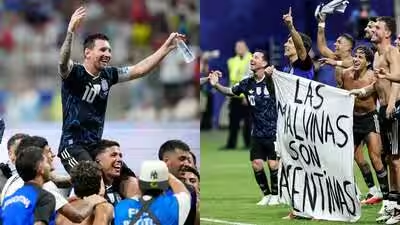
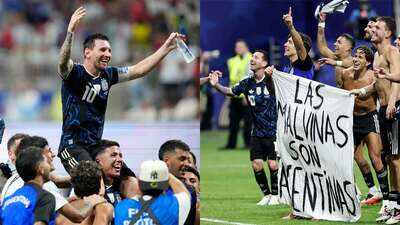
Argentina could face disciplinary action from FIFA after its players celebrated their 2026 FIFA World Cup semi-final victory over England by displaying a banner supporting the country’s claim to the Falkland Islands.The defending champions staged a dramatic comeback in Atlanta, scoring twice late in the match to beat Thomas Tuchel’s England 2-1 and book a place in Sunday’s World Cup final against Spain.After the final whistle, Argentina’s players celebrated with a banner that read “Las Malvinas son Argentinas”, which translates to “The Falklands are Argentine”.
Long-running Falklands dispute
The Falkland Islands are a British overseas territory in the South Atlantic Ocean. However, Argentina has long claimed sovereignty over the islands.The two countries fought a 74-day war over the islands between April and June 1982. The conflict claimed the lives of 655 Argentine servicemen, 255 British servicemen and three islanders.This is not the first time Argentina has taken action on the issue. In 2014 FIFA fined the Argentine Football Association £20,000 after players displayed a banner bearing the same message before a friendly against Slovenia.At the time, world soccer’s governing body ruled that the act violated its regulations on political action and team misconduct.
Argentina’s vice president reacts
After Wednesday’s victory, Argentina’s Vice President Victoria Villarruel celebrated the result on social media.“It wasn’t just another match,” he wrote alongside a video that appeared to show Argentine soldiers.Then he added: “The Falklands are Argentine. They have forbidden to bring to the stadium and forget that we carry them in our blood and our hearts.”Before the semi-final, Villarruel had also described the match as “putting the invaders in their place”.Argentina players have previously sung songs in reference to the Falklands, along with football legends Diego Maradona and Lionel Messiafter their dramatic 3-2 win in the last 16 over Egypt.Argentina will face Spain on Sunday at the MetLife Stadium as they look to become only the third nation to win back-to-back. FIFA World Cup titles