

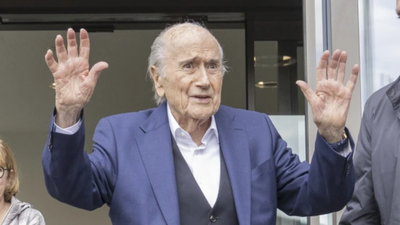
Former FIFA president Sepp Blatter has strongly criticized FIFA’s proposal to sell a minority stake in a new company that manages the commercial rights to the World Cup and other major tournaments, arguing that soccer’s biggest competition should never become an investment product for private investors.Blatter’s comments come as FIFA faces growing opposition to the proposal from UEFA, the Football Association (FA), Concacaf and other stakeholders. However, his intervention also drew widespread criticism on social media, with many supporters pointing to the corruption scandals that ended his own presidency.
Blatter says World Cup ‘belongs to the people’
Speaking to Reuters, Blatter condemned FIFA’s proposal to establish a new commercial subsidiary that would oversee the World Cup and other FIFA competitions while selling up to a 20% stake to outside investors.“Football belongs to no individual and no institution. It belongs to the people,” Blatter told Reuters.“If FIFA is transferred into a profit-oriented corporate structure, it will lose its soul.”Blatter said he was shocked by the proposal, insisting he had never considered such a move during his 17 years as FIFA president.“The FIFA World Cup is not a commercial asset that belongs to a handful of leaders,” he said.“It is part of the cultural heritage of world football.“FIFA is the guardian of the World Cup, not its owner.”The 90 year also argued that private equity investors looking for financial returns were fundamentally incompatible with the way football is traditionally governed.“Modern football has survived for more than a century because it belongs to the people,” Blatter said.“This principle must never change.”
Blatter also targeted Infantino on social media
Blatter also criticized current FIFA president Gianni Infantino in a post on X, linking the proposal to Infantino’s relationship with the US president. Donald Trump.“The close relationship between the president of FIFA and the president of the United States has reached a financial dimension that greatly damages football,” Blatter wrote.“No one has the right to sell our game.”The comments follow reports that FIFA is working with multinational financial services firm JPMorgan in a deal to establish FIFA Forward Enterprise, a new commercial entity that will oversee FIFA competitions and events. The proposed investment group would be led by Thrive Eternal, a fund launched by Thrive Capital founder Joshua Kushner, whose brother Jared Kushner is the son-in-law of US President Donald Trump.Under the proposal, FIFA would sell a 20% minority stake in the subsidiary at an estimated valuation of $20 billion, raising about $4.2 billion from private investors.FIFA said it will remain the majority owner of the company and retain full control over governance, regulations, competition planning and sporting decisions.FIFA president Gianni Infantino also wrote to the organization’s 211 member associations, giving them until September 19 to vote on the proposal.According to FIFA, the approval will unlock a $10 billion funding package starting in 2027, with each member association eligible to receive up to $40 million through a combination of one-off funding and FIFA Forward development grants.
The opposition continues to grow
Blatter’s criticism comes amid growing resistance from soccer’s governing bodies.UEFA described the proposal as one that “crosses a line that football’s governing institutions should never cross”, arguing that “the soul and governance of football are not good for trading”.The European governing body also confirmed it is calling an emergency meeting of its 55 member associations, with ESPN reporting that possible responses under discussion include a future World Cup boycott if the proposal goes ahead.The Football Association also said it was “completely unaware” of the proposal before media reports emerged and said it was “deeply concerned” by what it described as a lack of process, transparency and governance.Concacaf echoed those concerns, saying it only learned of the proposal through media reports before FIFA’s public announcement and described itself as “deeply concerned by the lack of due process.”
Social media users accused Blatter of hypocrisy
While Blatter’s criticism has attracted attention, much of the online backlash has focused on his own record as FIFA president.Many users argued that the former head of FIFA was ill-placed to criticize the governance after the scandals that have engulfed the last years of his administration.One social media user wrote: “Why is Sepp Blatter talking about corruption? He was worse than Infantino.”Another said: “Sepp Blatter; the man who led FIFA for 17 years and was banned for ethics violations is now the voice of moral authority on corruption in football. The fact that he is the most credible critic in this situation tells you everything about the depth of this rabbit hole.Former Liverpool defender Jamie Carragher He also appeared to mock Blatter’s comments by responding with a GIF of Donald Trump pointing directly at the camera.
Why Blatter left FIFA
Blatter served as FIFA president from 1998 to 2015 before resigning amid one of the biggest corruption scandals in the organization’s history.In May 2015, Swiss authorities, following indictments issued by the US Department of Justice, raided the Baur au Lac hotel in Zurich, where several high-ranking FIFA officials were staying.Seven senior FIFA officials have been arrested as part of a wide-ranging investigation into alleged corruption involving more than $150 million in bribes.The investigation examined matters including broadcasting and commercial rights, the allocation of hosting rights for major tournaments and votes in relation to the 2018 and 2022 FIFA World Cups.Although Blatter was re-elected FIFA president shortly after the arrests, mounting pressure from sponsors, UEFA and law enforcement led him to announce his resignation.Swiss prosecutors later opened a criminal investigation into a 2 million Swiss franc payment made by Blatter to former UEFA president Michel Platini in 2011.FIFA’s Ethics Committee subsequently suspended Blatter and Platini from football, initially imposing eight-year bans that immediately removed them from all football-related executive activities.Although both men were twice acquitted in Swiss criminal trials related to the payment, their football bans remained in place, bringing Blatter’s 17-year presidency to an end.His latest intervention therefore comes from a figure whose own tenure remains one of the most controversial periods in FIFA’s history, even as criticism of the government’s latest business plans continues to gather momentum in world football.