
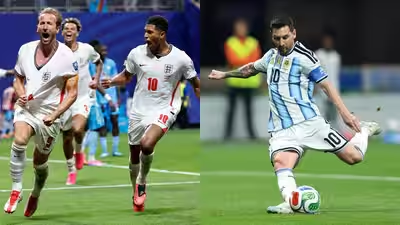
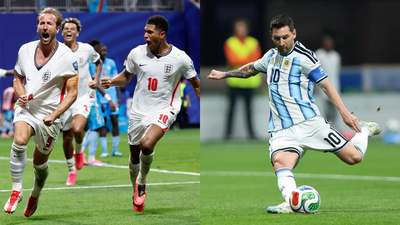
“Y ya lo ve, y ya lo ve. He who does not jump, is an Englishman!”“And now you see, and now you see, whoever doesn’t jump is English.”It is one of the most common songs among football fans and players of Argentina. Follow the team wherever it goes, regardless of the opposition. The Argentine supporters sing it from the stands. Players join after victories. It has become part of the Argentine football identity.England doesn’t even have to be the opposition for Argentina supporters to sing this slogan. However, as Argentina prepares to face the Three Lions in the FIFA World Cup Semi-final 2026 Thursday (IST) in Atlanta, these words will bring more hostility and emotions.Argentina vs England is a rivalry that spans generations. It is rooted in football, history, politics and colonialism, and after more than two decades of international career, more than 200 appearances and 125 goals, Lionel Messi will play against England for the first time as defending champions Argentina look to stop Thomas Tuchel’s England from reaching their first World Cup final since 1966.It’s a rivalry that started in 1962 and has since produced controversy, red cards, and some iconic goals.Political tensions and military conflicts, particularly those surrounding the Falklands War in 1982, continue to affect the relationship between the two football-crazed nations. Argentina players and supporters still refer to the conflict in football songs.After Argentina beat Switzerland in the quarter-finals, the celebrations continued in the dressing room. Videos shared by the Argentina Football Association showed the team singing together. One song honored Diego Maradona and Lionel Messi while also referring to the Falkland Islands.“For Malvinas, for Diego, for the last of Leo.”“For the Falklands, for Diego, for Leo’s last (tournament).”Las Malvinas is the name used in Argentina for the Falkland Islands, a British territory about 300 miles (480 km) off the east coast of Argentina.The two countries fought a war over the islands in 1982. The conflict lasted 74 days and ended with the surrender of Argentina. A total of 649 Argentine servicemen, 255 British servicemen and three Falkland Islanders were killed, while more than 2,300 others were injured.Even today, the Falklands remain a symbol of nationalism in Argentina.A look at international football’s fiercest rivalryIt is a rivalry shaped by decades of bitterness, where football and history often collide.The first meeting in the World Cup was in 1962, but the rivalry really intensified four years later.1962: England 3-1 Argentina (Rancagua, Chile – Group Stage)Compared to what followed, this match was relatively calm.Goals from Ron Flowers, Bobby Charlton and Jimmy Greaves put England 3-0 up before Argentina scored a late consolation.Both teams finished the group stage with a win, a draw and a defeat, but England progressed on goal difference.England were then knocked out by Brazil in the quarter-finals.1966: England 1-0 Argentina (Wembley, England – Quarter-finals)This remains the only World Cup that England has won.The quarter-final is still remembered in Argentina as a match they believe was stolen, with claims that Geoff Hurst’s winning goal was offside.It was not the only controversy in the game.Argentina captain Antonio Rattin was sent off in the 33rd minute after two fouls in three minutes. He refused to leave the field, delaying the game by almost eight minutes.England eventually won a tense contest.After the match, England manager Alf Ramsey described Argentina as “animals” and ordered his players not to swap shirts.The game also played a role in the later introduction of yellow and red cards, which highlights the need for better control of such heated contests.1986: Argentina 2-1 England (Mexico City, Mexico – Quarter Final)Played four years after the Falklands War, this remains the defining chapter of the rivalry. Diego Maradona scored the infamous ‘Hand of God’ goal by punching the ball past Peter Shilton, before producing the ‘Goal of the Century’ just four minutes later with a single run through the England defence. Argentina went on to lift the World Cup.1998: Argentina 2-2 England (Argentina won 4-3 on penalties) (Saint-Étienne, France – Round of 16)The match is remembered for David Beckham’s red card after kicking Diego Simeone.Gabriel Batistuta and Alan Shearer traded penalties before Michael Owen scored one of England’s best World Cup goals after a solo run.Argentina equalized before half time through Javier Zanetti.England still pushed Argentina after Beckham’s red card and even thought Sol Campbell had scored the winner before the goal was ruled out.Argentina eventually progressed after winning the penalty shootout.2002: Argentina 0-1 England (Sapporo, Japan – Group Stage)Four years later, Beckham had his chance for redemption.England won after Beckham converted a penalty awarded after Mauricio Pochettino’s foul on Michael Owen.England then defeated Denmark before losing to Brazil in the quarter-finals. Messi gets the date in England that football has been waiting for Lionel Messi has achieved almost everything in football. He has won the World Cup, two Copa America titles, several Champions League titles and almost every individual honor the sport has to offer. Yet he never faced England in his career.That changes on Thursday when Argentina meet England in the World Cup semi-finals in Atlanta.The Argentine Football Association described it as “the destiny of the party should Messi”.Many of Argentina’s iconic No. 10 have experienced this rivalry before him. Antonio Rattin said. Diego Maradona did his own thing. Ariel Ortega experienced it too.Messi now has his turn, at the twilight of his career.And so, 24 years after England and Argentina last met in a World Cup, one of football’s fiercest rivalries returns.For Messi, this will be his first game against England. For Argentina fans, from Buenos Aires to every corner of the world, they will hope that this will not be their last in an Argentina shirt.