Old and New NCERT Class 9 Social Science Textbooks: What’s Changed?
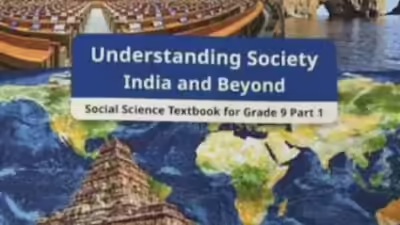
The revised NCERT textbook for Class 9 social sciences has come under scrutiny after changes related to the Constitution, secularism and Indian democracy.The controversy began after reports highlighted that the introductory chapter on the Constitution in the new textbook no longer contains a preamble. The words “secular” and “secularism” that appeared in earlier versions were also deleted from the text.NCERT, however, dismissed the claim that the preface has been removed from the curriculum. According to sources cited by ANI, the curriculum has been redesigned in line with the National Curriculum Framework and topics are now spread across different grade levels instead of being contained in one textbook.“The preface continues to appear in the opening pages of all new NCERT textbooks, including all social science textbooks. It is also part of the Class 10 syllabus,” NCERT sources told ANI.Sources added that constitutional values such as justice, freedom, secularism and socialism have been introduced in classes 6 to 8 and will be discussed in more detail in class 10.
Old and New: Major Changes in Textbooks
Constitutional Chapter
Early textbooks: A chapter on the constitution includes a preamble and explains concepts such as secularism in the text.New textbook: This chapter discusses constitutional values, institutions and governance, but the preamble is said not to be reproduced in this chapter. References to “secular” and “secularism” have also been removed from the text.
Emergency chapter
Early textbooks: Class 9 did not have a dedicated course on the 1975-77 emergency.New textbook: The revised textbook includes for the first time a separate section on the Emergency, calling it “one of the major challenges” to Indian democracy. During the state of emergency, most basic rights were suspended, the media was censored and many political leaders and activists were arrested, the report said. The chapter also highlights the role of Jayaprakash Narayan in leading the protests and says that the 1977 election results proved the strength of Indian democracy.
judicial
Early textbooks: Previous ninth-grade textbooks explained the judiciary’s role in interpreting the law, protecting citizens’ rights and ensuring that the Constitution is followed. New textbook: The revised textbook describes the judiciary as an “impartial and independent institution” that protects citizens’ rights and promotes the spirit of the Constitution. It said the judiciary can review executive actions and constitutional amendments, repeal unconstitutional laws and hear public interest litigations (PILs) to ensure access to justice.A few months ago, the Supreme Court objected to the reference to alleged judicial corruption in the NCERT Class 8 textbook, which was later withdrawn.
Election Commission and SIR
Early textbooks: Early ninth-grade textbooks explained voter lists and said they were revised periodically to keep them up to date. New textbook: The revised textbook introduces the Special Intensified Revision (SIR) of the Electoral Register by the Election Commission for the first time. It said the work helps ensure no eligible voters are excluded and no ineligible people are included on the electoral roll. The book also praises the Electoral Commission for conducting elections fairly despite challenges such as fake news, misinformation and intimidation.






















Post Comment